Why does my feed feel fake?
The dead internet theory, explained.
The recycled posts. The suspicious replies. The AI pictures everyone seems to believe. What the “dead internet” idea gets at—and where it goes too far.
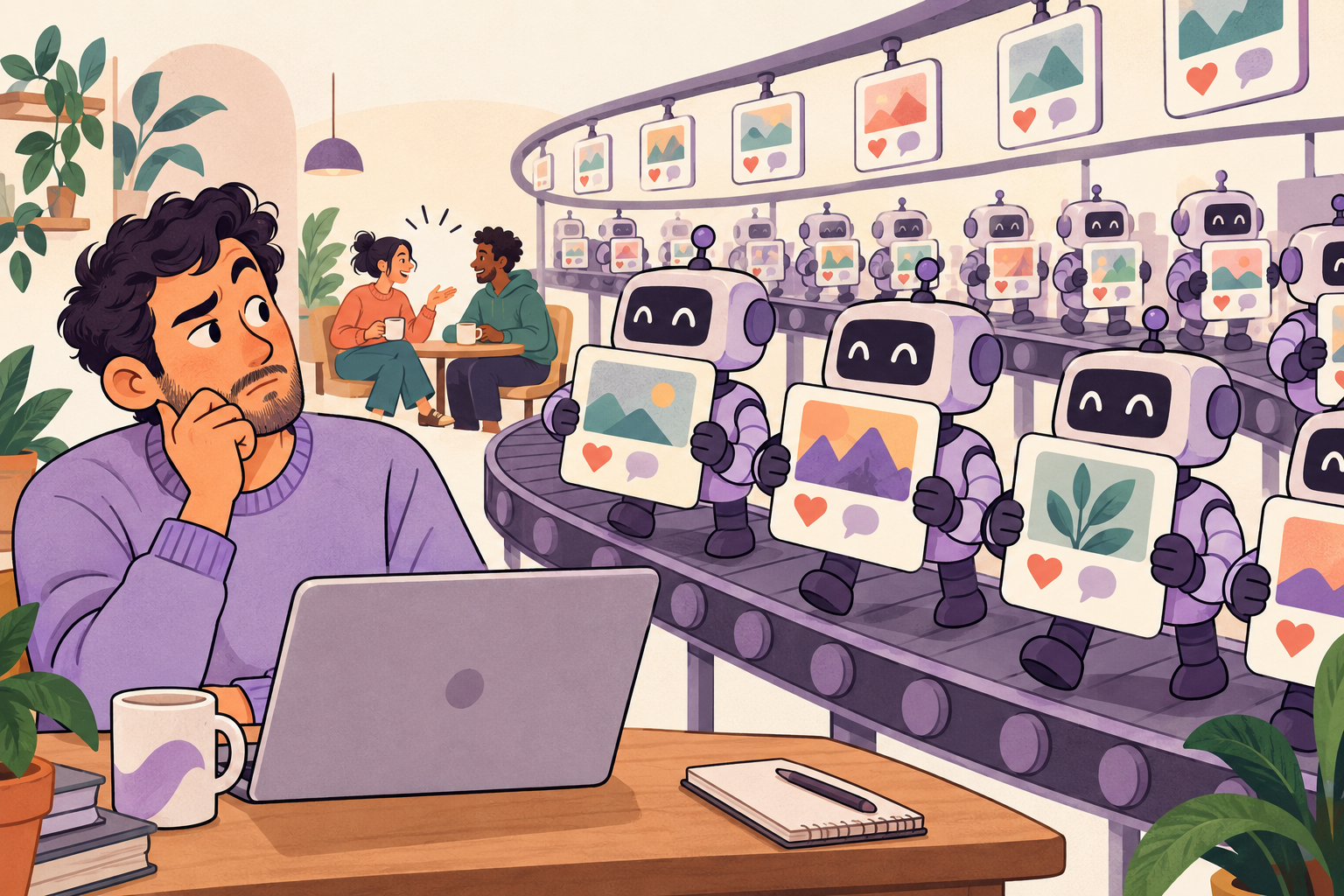
Dead internet theory is the idea that bots and synthetic content have displaced much of the internet’s genuine human activity. Automation, spam, and AI-generated posts are real. But the evidence below does not establish that most people online are fake or that a single hidden operation controls the internet. A repetitive feed is a reason to investigate, not proof of the whole theory. [1]
“This feels artificial” is a starting point.
You open an app and see a familiar pattern: a dramatic image, a caption asking for a reaction, and a comment section full of strangely similar praise. A few swipes later, another account has posted almost the same thing.
“Is anyone here real?” is an understandable reaction. Dead internet theory turns that feeling into a much broader explanation: online activity is increasingly manufactured, and authentic human participation has been pushed aside. A 2025 research review discusses this cluster of ideas around bots, generated content, and commercial incentives. It is a discussion of the theory, not a census proving it. [1]
Artificial activity exists.
Bots generate traffic. Some operators use AI images to attract audiences. Platforms report coordinated fake engagement.
Human participation is mostly an illusion.
That would require evidence about people, accounts, and interactions across the internet. These sources do not establish it.
The distinction matters because “fake” can mean several different things. A real person can publish a synthetic picture. A bot can share a useful weather update. A human can copy someone else’s post. None of those situations tells you, by itself, who wrote the next comment.
Our reading of the appeal is that the phrase names a loss of trust: you are no longer sure whether a post is someone sharing an experience or someone assembling content to collect your attention.
Bot traffic is not a head count.
Thales’s 2026 Bad Bot Report, analyzing 2025 activity, reports a traffic split of 53% bots and 47% humans. That is a finding about web traffic in a security vendor’s analysis—not the percentage of social-media users who are bots. [2]
Web traffic, not people
Thales · 2025 activity · Report published in 2026
A bot can make many requests without producing a single social post. Human users also generate many requests. You cannot convert a traffic share directly into a share of accounts, comments, or beliefs. “Bots produce lots of activity” and “most people I meet online are bots” are different claims.
This is why a frightening statistic needs a plain question attached: what, exactly, was counted? Traffic, accounts, posts, and people are different units. Swapping one for another can turn a useful finding into a misleading headline.
You do not need an empty internet to get a lifeless feed.
There is documented activity behind the uneasy feeling. In a March 2024 paper, researchers Renee DiResta and Josh A. Goldstein described spammers and scammers using AI-generated images to attract Facebook audiences. They also observed Facebook recommending unlabeled AI imagery to people who did not follow the posting pages. Their work documents a pattern, not the proportion of all Facebook content that was synthetic. [3]
Meta has acknowledged another part of the problem. In an April 2025 announcement, it described spam networks sharing identical content across many accounts and coordinating fake engagement. That is a platform’s own account of behavior it was trying to reduce; it is not independent proof of how common the behavior is everywhere. [4]
How a feed can fill up with repetition
An operator generates an image or copies an existing post.
A caption asks for praise, outrage, or a quick reply.
Reposts, sharing, or recommendations can expose it to new viewers.
A similar post appears again, sometimes from another account.
The important possibility is coexistence: artificial material and genuine reactions can occupy the same thread. A person may believe the image, laugh at it, criticize it, or pass it along without checking it. A synthetic picture does not turn everyone who responds into a synthetic person.
A feed is also a selection of things shown to you, not a representative sample of the entire internet. If you keep encountering one repetitive format, you have learned something about that experience. You have not measured everyone else’s conversations.
Three words that describe different parts of the problem
AI slop
A critical label for low-quality, repetitive, or misleading material mass-produced with generative AI. It is not a name for every use of AI.
Deepfake
Synthetic media imitating a real person’s appearance or voice. An invented fantasy scene is not automatically a deepfake.
Engagement farming
Posting mainly to collect reactions. It can use AI, automation, recycled media, or an entirely human-written post.
These labels can overlap. They are more useful when you say which part you mean: the account’s behavior, the media’s origin, or the way the post seeks attention.
A suspicious post is a question, not a verdict.
Consider the fictional post below. The vague backstory and request for praise give you reasons to look closer. They do not establish whether a bot published it or whether the picture is real.
“My uncle made this entire castle by hand. Nobody appreciates real talent anymore. Can he get some love?”
Show the reading
What you can observe
The story names no maker or location. It asks for validation. Two sample replies repeat the same phrase.
What remains unknown
Who runs the account, how the image was made, and whether any replies are automated. Repetition alone cannot answer those questions.
A useful next step: Look for the original creator and a fuller account of the work. A repost chain is not independent confirmation.
All names, wording, comments, and artwork in this example were created for this article. No real account is being accused of deception.
Notice how quickly the question can change from “Where did this picture come from?” to “Nobody online is real.” The first is specific enough to investigate. The second is too broad to settle from a screenshot.
The same caution applies when a post irritates you. Rage bait describes deliberate provocation, not proof of automation. A real person can be very good at manufacturing an argument.
Find a source, not just a sign of life.
You do not need to prove the internet is alive before choosing what deserves your time. Start with the post in front of you.
- Find the original. Follow links to the creator, full video, study, or announcement. Search distinctive wording or try a reverse-image search. A matching image can reveal earlier context; no match does not prove it is genuine.
- Check the claim separately. “A person posted this” and “this happened” are different questions. Look for reporting or records that do more than repeat the same upload.
- Treat visual oddities as clues. Strange details can justify a closer look. Clean-looking hands, polished prose, or an AI label by themselves do not settle every question about an image or account.
- Choose some of your own destinations. Visit creators directly, return to a well-moderated community, or follow a publication you can hold accountable. Those choices do not guarantee truth, but they give you a clearer sense of who is speaking.
There is a trap in becoming suspicious of everything: it can make a careful human explanation feel no more credible than an anonymous repost. The goal is to improve your reasons for trusting a particular source, not to abandon trust altogether.
The internet does not have to be “dead” for your feed to need better sources.Gen Alpha Dictionary’s editorial takeaway.
Sources and editorial notes
Sources checked October 4, 2026. Publication years and measurement periods are stated separately. The traffic graphic uses reported figures; the other visuals are explanatory examples, not collected social-media evidence.
- Muzumdar et al.: The Dead Internet Theory: A Survey on Artificial Interactions and the Future of Social Media · 2025. Research review used to frame the theory, not to estimate the share of fake users.
- Thales: 2026 Bad Bot Report · 2025 activity. Source for the rounded 53% bot / 47% human traffic split. See also the April 29, 2026 release and methodology summary. Vendor research, not a count of social-media users.
- DiResta & Goldstein: How Spammers and Scammers Leverage AI-Generated Images on Facebook for Audience Growth · March 19, 2024. Research paper documenting uses of AI imagery and observed recommendations; not a platform-wide prevalence estimate.
- Meta: Cracking Down on Spammy Content on Facebook · First published April 24, 2025; page also shows an October 22, 2025 update. First-party description of spam networks and coordinated fake engagement.
The hero illustration was generated with AI for this article and is labeled accordingly. The castle graphic, fictional post, content-flow diagram, and practical reading suggestions are original editorial material. Using AI to make a disclosed illustration is not evidence about whether another person’s post is genuine.
Know which kind of “fake” you mean.
Explore the companion definitions, or keep reading about how online outrage attracts attention.
Read next: Why does everything online feel like rage bait? →
A“Amazing work!”
B“So talented!”
C“Amazing work!”